
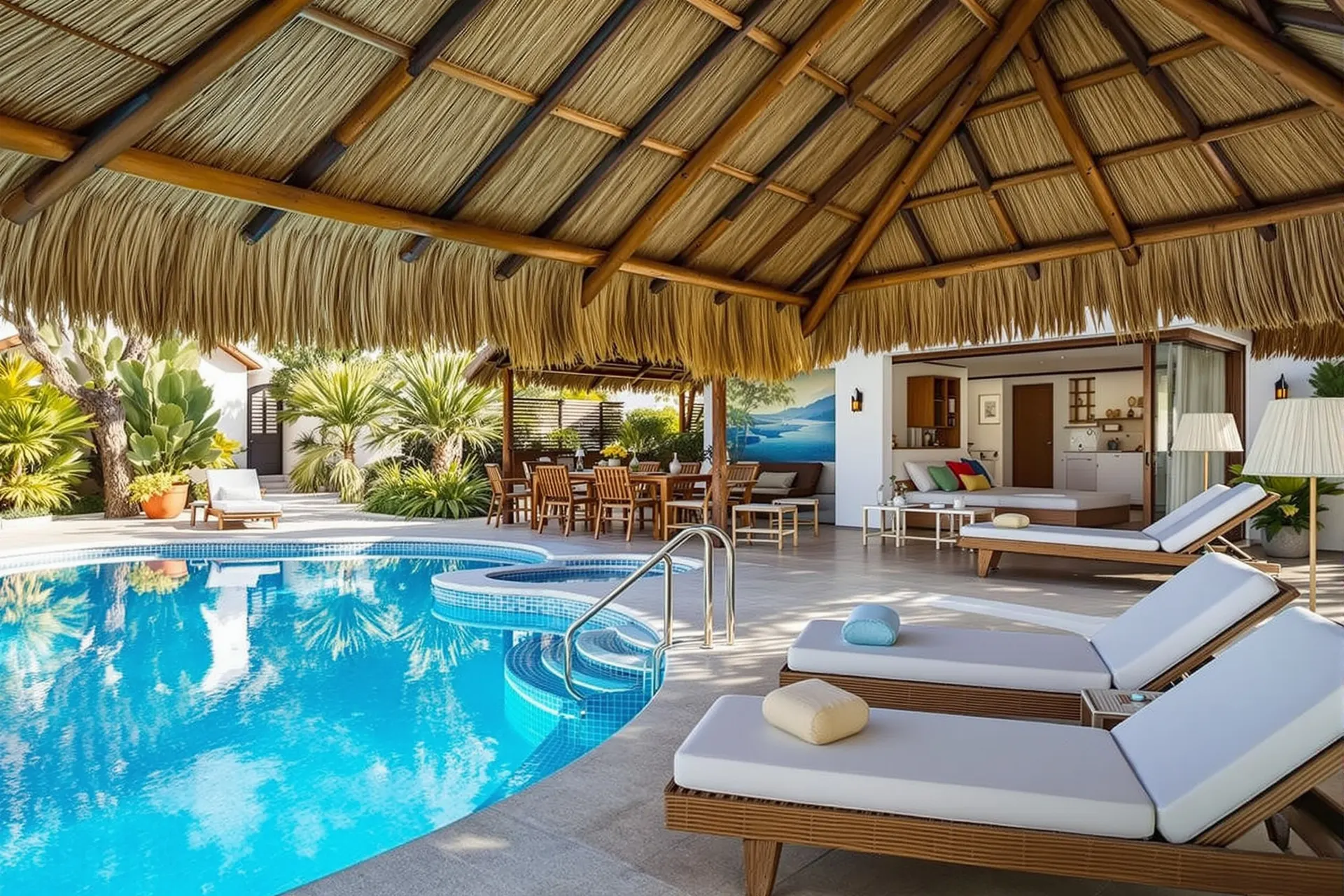
NSG Bamboo Center
Thatched roof pitch is the angle between the roof and the horizontal, and it decides how quickly rain runs off. Sources in the industry quote different values; in general, pitches of roughly 30 to 50 degrees are mentioned, and many accounts highlight the 35-45 degree band. Because there is no single official standard, the suitable pitch is set project by project.
In short: A lower pitch leaves water on the roof and wears the thatch with moisture; a steeper pitch sheds water faster but needs more material and labour. The right pitch is decided at the survey based on thatch type, climate, support structure and design.
Why does pitch matter so much for thatch?
Because a thatched roof gets much of its water protection from pitch and dense weaving. Water slides along the reed stems and leaves at the drip line. With too little pitch, water stays longer on the surface, moisture works in, and the roof becomes open to moss, rot and early wear.
The effect is not only about water. Steeper roofs shed leaves, dust and damp more easily and dry faster. Very steep roofs, on the other hand, need more material, longer labour and more careful fixing. In windy regions, roof geometry also changes the load on the structure.
What pitch should a thatched roof have?
There is no single figure in the sources; the values differ depending on roof type, thatch type and installation method. The table below summarises commonly heard claims in the industry as a rough frame, not a binding standard.
| Structure | Range mentioned in the industry | Note |
|---|---|---|
| Reed thatch roof | About 30-50 degrees | Many accounts say 35-45 degrees |
| Hedgehog thatch | About 35-45 degrees and above | Dense, multi-layer weave works with a steep pitch |
| Gazebo, pavilion | About 35-50 degrees | Varies with form and look |
| Ready mat panels, rolls | Varies with product and underlayer | Usually needs an underlayer |
To see why these ranges vary, look at three factors: bundle thickness, weave density and the roof's underlayer. A thick, tightly woven hedgehog roof and a thin ready panel do not behave the same at the same angle. So applying a number you saw online directly to your project would not be right.
How is the right pitch chosen?
The right pitch is not a single number; it comes from evaluating the site, climate, support structure and design together. These steps make the choice easier.
- Clarify the use: A gazebo, restaurant terrace, bungalow or pool bar affects both pitch and look.
- Consider the climate: Rainy, windy or humid regions call for more careful pitch and fixing.
- Check the structure: If the existing frame does not suit a certain pitch, a new structure or a different form is considered.
- Pick the thatch type: Hedgehog, stepped or mat panels have different pitch needs.
- Decide on an underlayer: Low-pitch or panel installations may need an extra waterproofing layer.
- Confirm on site: A firm pitch is not given without seeing size, orientation and surroundings.
If you want thatch on a flat or nearly flat roof, that usually means a different covering, an extra waterproofing layer or a custom design instead of plain natural thatch. NSG Bamboo Center evaluates such requests at the survey as custom design. To see the covering up close, visit the Premium Reed Mat Roof and Beach Cabana Roof pages.
What problems appear when the pitch is wrong?
When pitch is too low, the most common problems are standing water, trapped moisture and early wear. These issues are often unnoticed at first and show over time in the colour, texture and strength of the covering.
- Water and leaf build-up on the surface, moss growth
- Risk of rot at the base of the bundles
- Dripping and leak complaints
- Earlier-than-expected renewal of the covering
- Strain on fixing points in wind
The best way to prevent pitch problems is to discuss the plan before installation. NSG Bamboo Center's Aydın-based team inspects the site within its consulting service, and you can see the areas it serves across Türkiye on the service regions page. For older roofs that need attention, maintenance and repair is available.
Look also plays a role in the pitch decision. A steep thatched roof creates a distinct, traditional character in the silhouette, while a flatter, wider form gives a modern and airy appearance. Between these two choices, water runoff, structure cost and wind behaviour also change. So pitch is not just a technical value but one of the main design decisions.
Regional conditions also affect pitch. Where rainfall is heavy or humidity stays high, quick runoff matters; on windy coasts, how the roof form handles wind load is evaluated. Surrounding trees, shaded areas and neighbouring buildings also decide how quickly the roof dries. Surfaces that stay in shade and hold moisture for long need a more careful pitch and maintenance plan.
It should be remembered that pitch alone is not a guarantee. At the same pitch, a tightly woven, well-fixed roof and a loosely installed one give very different results. So pitch must be considered together with material quality and workmanship.
In practice, pitch is confirmed by site measurement. If thatch is to be applied over an existing structure, the real pitch of the roof, the condition of the rafters and the evenness of the underlying surface are measured and compared with the needs of the planned covering. If the pitch is insufficient, options such as adjusting the structure, proposing a different roof form or adding an extra underlayer are discussed together. This leads to a solution that is both safe and aesthetically satisfying.
Frequently asked questions
Is there a fixed pitch standard for thatched roofs?
There is no single binding figure; the industry mentions roughly 30-50 degrees, often recommending the 35-45 degree band. The suitable pitch is set at the survey based on the project.
Can thatch be used on a low-pitch roof?
With a low pitch the risk of standing water rises, so an extra underlayer, a different covering or a custom design may be needed. An on-site evaluation is essential.
Does a steeper pitch extend roof life?
Generally a steeper pitch helps water and moisture leave quickly and supports lifespan. Still, lifespan also depends on material, workmanship, climate and care, so no exact number of years can be promised.
Can thatch be applied without changing my existing roof pitch?
In some cases yes, in others the structure needs changes. A preliminary review can start from measurements and photos.
To define the right pitch for your space, submit a free survey and quote request or book an appointment.