
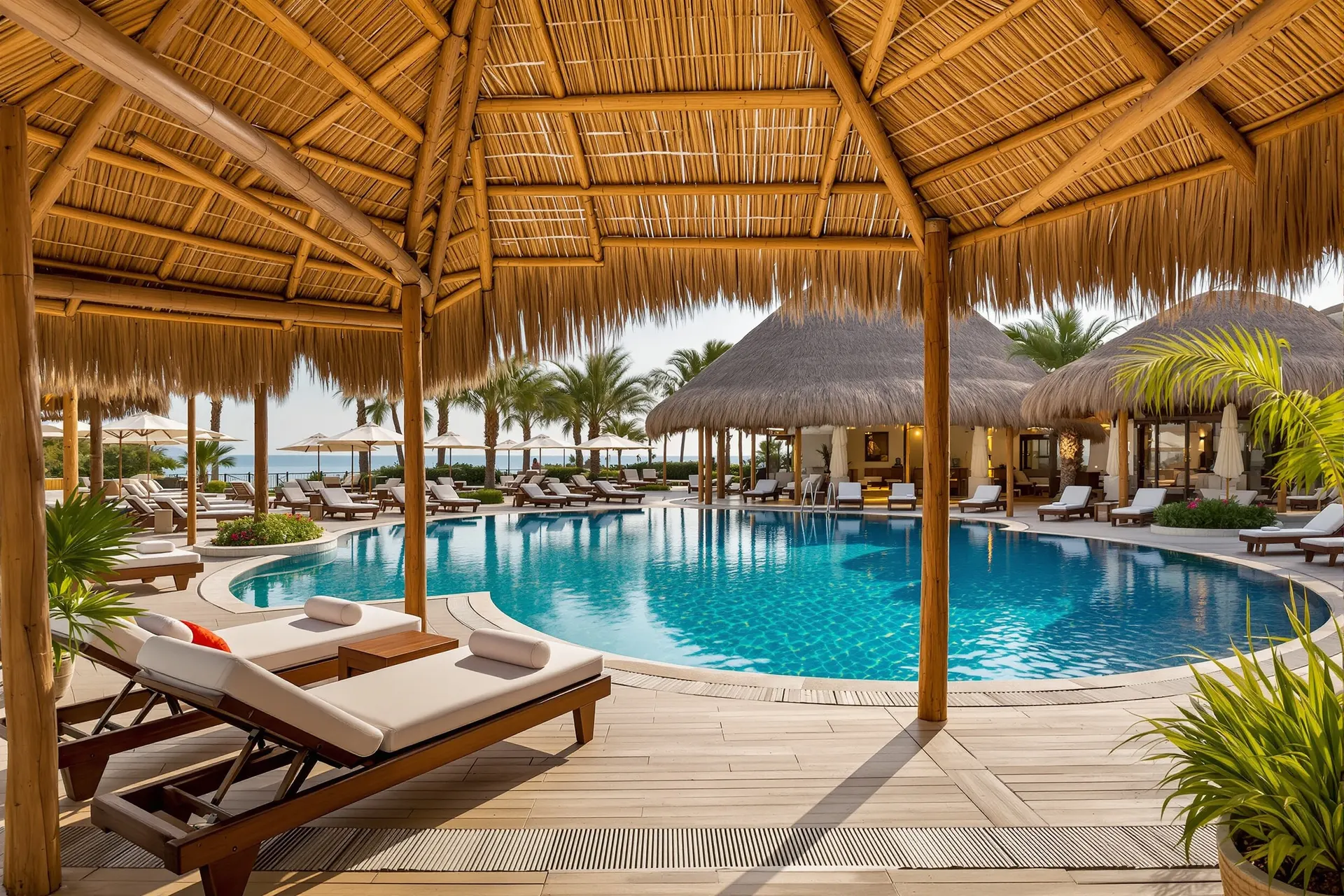
NSG Bamboo Center
Two questions come to mind for anyone considering a thatched roof: does it burn, and does it let rain through? They are very fair questions. Natural material looks beautiful and adds warmth, but fire safety and water protection need to be planned knowingly. In this article we sketch a general and cautious framework for thatched roof fire safety and waterproofing. One important note: the information here is general guidance; firm decisions for each project are made at the site survey, with the right people, according to the type of structure, its use and the relevant regulations.
In short: Dry thatch and reed are combustible natural fibers; no natural roof can be called fireproof, but the risk can be managed when planned properly. Against rain, the basic defense is dense, thick laying with enough slope, with an underlayer planned if needed. Final decisions are made at the survey according to the structure, its use and regulations.
Thatched roofs and fire: an honest look
Dry reed and thatch are combustible, because they are natural fibre. There is no point hiding it; the honest approach is to know the risk and take precautions. Fire risk varies with the position of the roof, nearby heat and spark sources, how dry the material is and how the space is used. A thatched roof carries a risk that can be managed when properly planned, but it would not be right to call any natural roof "fireproof."
Exact fire performance values, certificates and requirements vary by project and local regulation. For that reason we do not promise any particular standard or class; we discuss the necessary conditions at the survey and recommend that you proceed in line with the relevant authorities. Where needed, taking the view of the competent authority or a fire specialist is the right course.
General measures that reduce fire risk
The following are approaches based on general reasoning, not a firm guarantee:
- Distance from heat sources: position barbecues, fireplaces, chimneys, stoves and heaters at a safe distance from the roof surface. The distance is set at the survey according to the structure and the heat source.
- Electrics and lighting: prefer lighting beneath the roof that does not generate heat, is safely insulated and properly installed. Do not leave cables touching the roof material.
- Open flame and sparks: keep candles, torches, fireworks and cigarettes away from the roof.
- Cleanliness: dry leaves and twigs collecting on the surface can add to the fire load, so regular cleaning helps.
- Protective treatments: fire-retardant treatments that can be applied to natural material exist on the market. Their effect varies by product and application, and instead of quoting a figure we assess the need together at the survey.
- Readiness to respond: keeping suitable extinguishing equipment on site and exits clear matters especially in commercial venues.
Waterproofing: how does a thatched roof handle rain?
A thatched roof's basic defence against water rests on two things: densely and thickly laid thatch and enough slope. Because bundles overlap one another, rainwater runs down over the surface of the layers. With enough pitch, water leaves quickly and the material dries in a short time. This is one of the most important factors in the long life of a natural roof.
That alone may still not be enough for every structure. On thin surfaces such as mat panels, or in regions with heavy rainfall, an extra waterproof layer can be planned under the roof. In spaces that are enclosed underneath, such as restaurant interiors or accommodation areas, keeping water out is far more critical. So the intended use of the structure must be known from the start.
Where leaks most often occur
- Ridge line: where two surfaces meet is where water is most likely to get in; it needs extra protection.
- Joints and penetrations: water can collect around posts, chimneys or roof windows.
- Edges and eaves: badly cut or loosened ends can direct water inward.
- Low-slope sections: where water lingers, the material wears faster.
Thinking about fire and waterproofing together
The two topics can seem to pull against each other: more layers handle water better but also mean more combustible material. The combustibility of whatever is chosen as an underlayer matters too. A good design balances both needs according to the real use of the space. To strike that balance, the purpose, heat sources, rainfall and roof pitch are assessed together.
Because rain and wind vary from region to region, the same roof solution may not behave the same everywhere. For information about your area, see the service regions page.
Questions to ask at the survey
When requesting a quote for a thatched roof, we suggest asking:
- Is the roof slope sufficient for this structure?
- Is an extra waterproof layer needed for a space enclosed underneath?
- What safety distance should apply to heat sources near the roof?
- Are fire-retardant treatments needed, and should the relevant authorities be consulted?
- How should the care and inspection interval be planned?
To get clear answers, our Consulting service offers a free survey. At the installation stage, our Installation team applies the roof according to the agreed plan. You can find product options on the Premium Reed Mat Roof page. After the roof is built, the Maintenance and Repair service is available for periodic checks.
Frequently asked questions
Can a thatched roof catch fire?
Yes, dry thatch and reed are combustible because they are natural fibers. The risk varies with the roof's location, nearby heat and spark sources, how dry the material is and how the space is used, and it can be managed with proper planning.
How close can a barbecue or fireplace be to a thatched roof?
No fixed distance is given; it is determined during the survey according to the structure and the heat source. As a general principle, barbecues, fireplaces, chimneys and heaters should be placed at a safe distance from the roof surface.
Does a thatched roof let rain through?
Dense, thick thatch with enough slope lets water run quickly down over the layers. On thin surfaces such as mat panels, or in very rainy regions, an extra waterproofing layer may be planned; this is more critical where the space below is enclosed.
Where do leaks occur most often?
Most often along the ridge line, because the point where two surfaces meet is where water is most likely to get in. Transitions such as posts and chimneys, badly cut edges and low-slope sections also need attention.
Free survey and quote
Fire safety and waterproofing are two topics not to be overlooked on a thatched roof. It would not be right to say anything firm without seeing your space, so the first step is the survey. Request a free survey and price offer on the Get a Quote page, or choose a day on the appointment page.